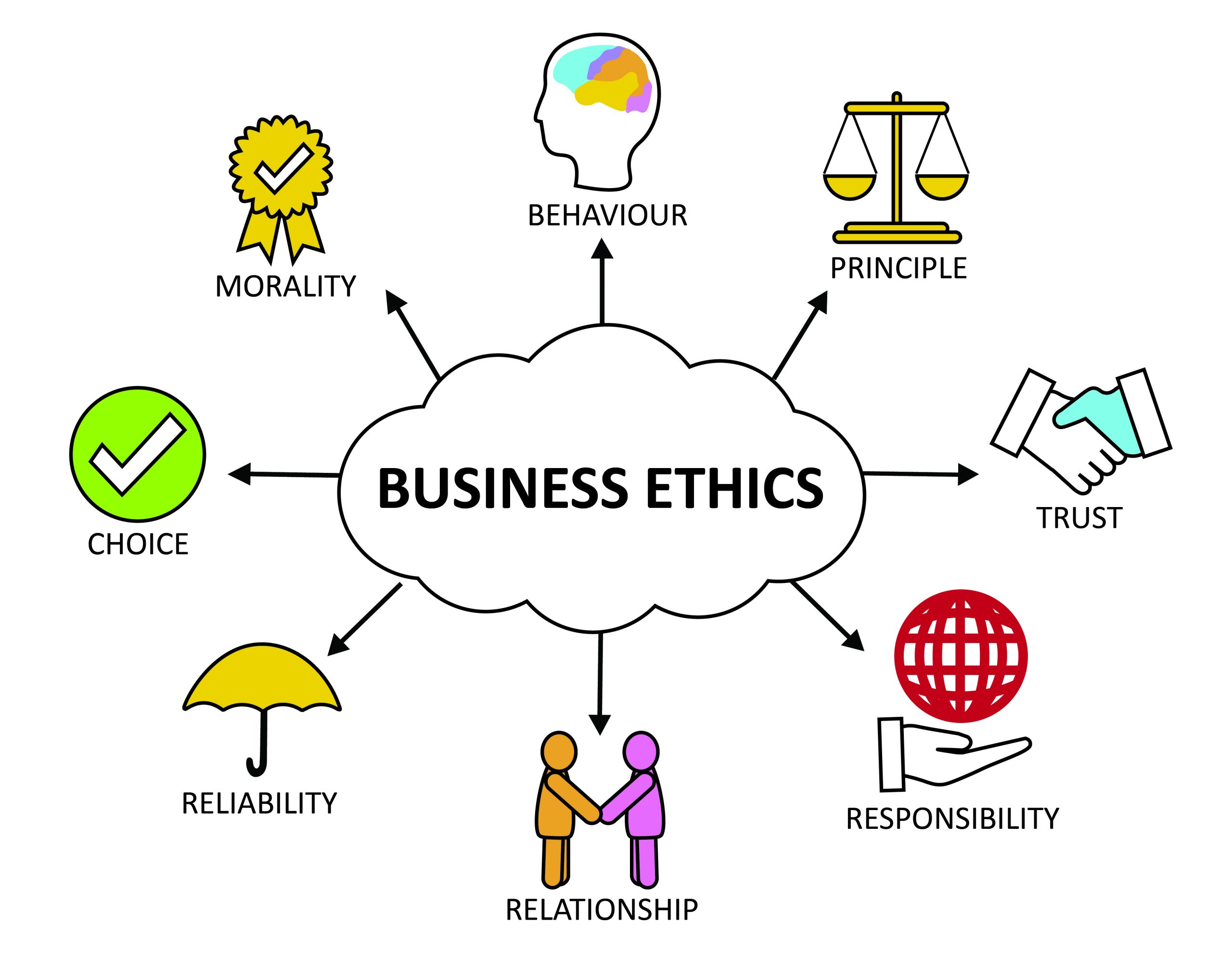
Business ethics is the behavior that a business adheres to in its daily dealings with the world. The ethics of a particular business can be diverse. They apply not only to how the business interacts with the world at large, but also to their one-on-one dealings with a single customer.
Many businesses have gained a
bad reputation just by being in business. To some people, businesses are
interested in making money, and that is the bottom line. It could be called
capitalism in its purest form. Making money is not wrong in itself. It is the
manner in which some businesses conduct themselves that brings up the question
of ethical behavior.
Good business ethics should be a part of every business. There are many factors to consider. When a company does business with another that is considered unethical, does this make the first company unethical by association? Some people would say yes, the first business has a responsibility and it is now a link in the chain of unethical businesses.
Many global businesses, including most of the major brands that the public use, can be seen not to think too highly of good business ethics. Many major brands have been fined millions for breaking ethical business laws. Money is the major deciding factor.
If a company does not adhere to
business ethics and breaks the laws, they usually end up being fined. Many
companies have broken anti-trust, ethical and environmental laws and received
fines worth millions. The problem is that the amount of money these companies
are making outweighs the fines applied. Billion dollar profits blind the
companies to their lack of business ethics, and the dollar sign wins.
A business may be a
multi-million seller, but does it use good business ethics and do people care?
There are popular soft drinks and fast food restaurants that have been fined
time and time again for unethical behavior. Business ethics should eliminate
exploitation, from the sweat shop children who are making sneakers to the
coffee serving staff who are being ripped off in wages. Business ethics can be
applied to everything from the trees cut down to make the paper that a business
sells to the ramifications of importing coffee from certain countries.
In the end, it may be up to the
public to make sure that a company adheres to correct business ethics. If the
company is making large amounts of money, they may not wish to pay too close
attention to their ethical behavior. There are many companies that pride
themselves in their correct business ethics, but in this competitive world,
they are becoming very few and far between.
Sources
of Business Ethics
Ethics in general refers to a
system of good and bad, moral and immoral, fair and unfair. It is a code of
conduct that is supposed to align behaviors within an organization and the
social framework. But the question that remains is, where and when did business
ethics come into being?
Primarily ethics in business is
affected by three sources - culture, religion and laws of the state. It is for
this reason we do not have uniform or completely similar standards across the
globe. These three factors exert influences to varying degrees on humans which
ultimately get reflected in the ethics of the organization. For example, ethics
followed by Infosys are different than those followed by Reliance Industries or
by Tata group for that matter. Again ethical procedures vary across geographic
boundaries.
Religion. It
is one of the oldest foundations of ethical standards. Religion wields varying
influences across various sects of people. It is believed that ethics is a
manifestation of the divine and so it draws a line between the good and the bad
in the society. Depending upon the degree of religious influence we have
different sects of people; we have sects, those who are referred to as orthodox
or fundamentalists and those who are called as moderates. Needless to mention,
religion exerts itself to a greater degree among the orthodox and to lesser
extent in case of moderates. Fundamentally however all the religions operate on
the principle of reciprocity towards ones fellow beings!
Culture. Culture
is a pattern of behaviors and values that are transferred from one generation
to another, those that are considered as ideal or within the acceptable limits.
No wonder therefore that it is the culture that predominantly determines what
is wrong and what is right. It is the culture that defines certain behavior as
acceptable and others as unacceptable.
Human civilization in fact has
passed through various cultures, wherein the moral code was redrafted depending
upon the epoch that was. What was immoral or unacceptable in certain culture
became acceptable later on and vice versa.
During the early years of human
development where ones who were the strongest were the ones who survived!
Violence, hostility and ferocity were thus the acceptable. Approximately 10,000
year ago when human civilization entered the settlement phase, hard work,
patience and peace were seen as virtues and the earlier ones were considered
otherwise. These values are still pt in practice by the managers of today!
Still further, when human
civilization witnessed the industrial revolution, the ethics of agrarian
economy was replaced by the law pertaining to technology, property rights etc.
Ever since a tussle has ensued between the values of the agrarian and the
industrial economy!
Law. Laws
are procedures and code of conduct that are laid down by the legal system of
the state. They are meant to guide human behavior within the social fabric. The
major problem with the law is that all the ethical expectations cannot be
covered by the law and specially with ever changing outer environment the law
keeps on changing but often fails to keep pace. In business, complying with the
rule of law is taken as ethical behavior, but organizations often break laws by
evading taxes, compromising on quality, service norms etc.
Business Ethics and
Organizations
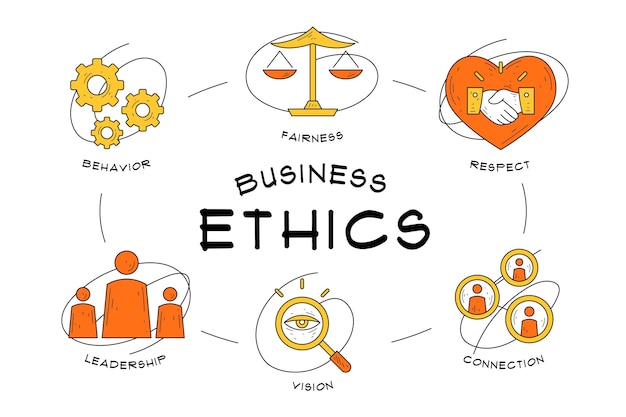
Business ethics (also corporate
ethics) is a form of applied ethics or professional ethics that examines
ethical principles and moral or ethical problems that arise in a business
environment. It applies to all aspects of business conduct and is relevant to
the conduct of individuals and entire organizations. Business ethics can
be thought of as written and unwritten codes of principles and values that
govern decisions and actions within a company. In the business world, the
organization’s culture sets standards for determining the difference between
good and bad decision-making and behavior.
As in other social entities,
ethics are inevitable in organizations. Research has already shown that ethics
do pay. Since unethical practices cost industries billions of dollars a year
and damage the images of corporations, emphasis on ethical behavior in
organizations has increased over the recent years. Societal expectations, and
pressures from legal and professional bodies have forced organizations to be
more concerned about their social responsibilities and ethical practices.
In the mid-1990’s Shell faced
one of its worst public relations nightmare due to its unethical business
practices in Nigeria. In 1997 the Financial Times in its annual survey of
Europe’s most respected companies identified Shell’s ethical problems as the
key reason for the company’s dramatic drop in rankings. Shell turned upside
down in the aftermath of these unfavorable experiences and thus started
correcting itself for sustainable growth. Like Shell, many other organizations
whose business practices are perceived to be unethical and their products are
considered to be harmful to the consumers (e.g. cigarettes) face strong social
condemn. In recent corporate history, the Enron and Arthur Anderson episodes,
stress the importance of ethical practices in business.
Ethical problems are problems
of choice. Ethical problems arise not because of people’s tendency to do evil,
but because of the conflicting nature of standards and interests, which are valid
in themselves. Problems in ethical decision-making and behavior occurs only
when individual interests and social norms conflict with each other.
Every organization has its own
accountability towards its stakeholders — employees, capital investors, consumers,
government, competitors, suppliers, and other community members. In most
situations the organizations are able to balance its obligations towards these
varied stakeholders. However, sometimes conflicts do arise between the
interests of two or more stakeholders. In such situations the more influential
and powerful group could gain precedence over others, to protect their own
interests.
/GettyImages-658647254-5468427ab5c94e9b82f9132e60aad7a0.jpg)
For example, though maximizing
financial returns is an organization’s obligation towards its shareholders, it
could be at the cost of the ecological system or legal business practices.
Managers under these situations face the dilemma of protecting long-term
interests of the organizations and short-term profits. Recent thrust on high
output driven performance and reward linkages in organizations is driving to
short-term interests. It might adversely affect the adherence to ethical norms
in organizations.
In order to ensure ethical
business practices of an organization, it is important to ensure ethical
orientation of the people who own, manage, and work for it. Adopting proper
structures and practices could ensure it. Structure, policies and practices of
an organization influence ethical behavior through flow of communication,
reinforcements for ethical behavior etc.
There are two ways that
companies can approach and implement the concept business ethics. These two
approaches are based on two schools of thought, each providing a different
definition for ethics business. The first school of thought is
shareholder-focused. It maintains that ethical business decisions can be made
when individuals within the organization and the company as a whole always keep
the best interest of the owners in mind. For those who see business ethics from
the shareholders’ perspective, actions and decisions should be geared towards
generating more profit. On the other hand, the stakeholder-focused approach
puts premium on corporate social responsibility. Under this concept, ethical
companies are those that act and decide with the interest of all stakeholders
not just the owners in mind. ethics business means striking a balance to
service all groups that have an impact on, or are impacted by the company’s
decisions and actions. These stakeholder groups can include the employees, the
supply chain, the end consumers, relevant government and non-government
organizations, and the community where the company operates, among others.
Given this, the stakeholder perspective emphasizes the need to make business
decisions that will work well for all the stakeholder groups.
Ethical Behavior in Business
Ethics in business is not a new
trend. In fact, it is already present for over four thousand years now. With
the changing trends in the business world, the society is getting more
concerned about the corporate responsibility of businesses. Debates have also
been conducted focusing on the social issue of poverty among the workers and
the corresponding responsibility of the employers about the issue. Even in the
ancient times, issues on ethics in business can be observed just like in the
teachings of Aristotle about the harmful effects of the gaps that exist between
the economical utilization of goods and the profit making objective of many
merchants. At present, the rise of the concept of corporate social
responsibility among the business sector constitutes corporate initiatives
of integrating several ethical aspects such as establishment of codes of
conduct, environment management system measures, health and safety in the
workplace, compliance to financial reporting standards, certifications
schemes, company partnerships with community groups, and support for projects
that are aimed for community development.
There are several factors for
the demand of the society for business ethics as a corporate responsibility.
Some of these include the changing social role of corporate entities,
globalization, developments in technology, and moral authority democratization.
In the past, the responsibility or regulating all aspects of social life rests
in the hands of the government. However, with the evolution of time, some
duties are being moved from the government to the other sectors of the society
including the individuals, the social groups, and the business sector. With
this trend, corporate entities are required to establish their own
self-regulation policies especially that the government has recognized the fact
that fully controlling the business sector is not always an efficient way of
influencing corporate behavior. Increased pressure is put on the business
sector about the possible consequences of their policies on the society.
Globalization is another
driving factor for the society’s demand of business ethics among the
business sector. Currently, many businesses enter the international market and
corporations tend to invest worldwide since this gives them more opportunities
to grow. However, with the trend of entering in different foreign markets,
there are complex things to consider including ethics. Customs and traditions
in foreign lands differ from each other and some business practices that may be
acceptable to one nation may not be accepted in the same sense in another.
Businesses are often expected to adapt with the customs and values of the
foreign land that they are trying to penetrate. Pressure on company’s corporate
social responsibility is high since there is still no firm and effective
supervision governing the international business behavior.
Developments in technology seem
to be a great source of questions of morality. Technology at the current time
is considered advanced and it provides a way for people to experience things
that are thought to be impossible before. Technological development brings
convenience to the society and contributes to the establishment of a kind of life
that is better than before. Ethics come to picture as the society examines the
real consequences of technology to the way of life. The effect of technology to
the world is complex and the government has not enough capacity to handle the
issues accompanying it which makes it necessary for the business sector to take
actions on whatever consequences their own technology may bring.
In the past, moral authority
often rests among a few groups in the society including the Church, the
government, and the theorists. At present, the opinions of the mentioned
authorities are now considered as a regular opinion which can be aligned with
the opinions of a regular entity. The power and control they once had over
judging and handling ethical issues has faded and now there is a
democratization of moral authority. This again puts pressure on the business
sector to manage their ethical affairs seriously since everyone seem to have
the authority to criticize their business practices are compliance to ethical
standards. Businesses are compelled to open their policies to the public when
questioned about their business ethics. Moreover, with the intrusion of media,
the businesses are more exposed to public which makes them susceptible to any
ethical criticism.
The relationship of a business
to its stakeholders is the primary concern of business ethics. Stakeholders may
include all the entities that have interest on a company or are influenced by
the company such as the shareholders, the customers, the employees, suppliers,
competitors, the government, and others. Seeking business strategies that will
consider the interest of all the stakeholders is not an easy task for a company
but an important mission of every manager and all the high ranking company
officials.
Examples
of Business Ethics
Here are a few examples of
business ethics at work as corporations attempt to balance marketing and social
responsibility. For example, Company XYZ sells cereals with all-natural
ingredients. The marketing department wants to use the all-natural ingredients
as a selling point, but it must temper enthusiasm for the product versus the
laws that govern labeling practices.
Some competitors'
advertisements tout high-fiber cereals that have the potential to reduce the
risk of some types of cancer. The cereal company in question wants to gain more
market share, but the marketing department cannot make dubious health claims on
cereal boxes without the risk of litigation and fines. Even though competitors
with larger market shares of the cereal industry use shady labeling practices,
that doesn't mean every manufacturer should engage in unethical behavior.
For another example, consider
the matter of quality control for a company that manufactures electronic
components for computer servers. These components must ship on time, or the
manufacturer of the parts risks losing a lucrative contract. The
quality-control department discovers a possible defect, and every component in
one shipment faces checks.
Unfortunately, the checks may
take too long, and the window for on-time shipping could pass, which could
delay the customer's product release. The quality-control department can ship
the parts, hoping that not all of them are defective, or delay the shipment and
test everything. If the parts are defective, the company that buys the
components might face a firestorm of consumer backlash, which may lead the
customer to seek a more reliable supplier.
Business
Ethics: A Successful way of conducting business
Business Ethics refers to
carrying business as per self-acknowledged moral standards. It is actually a
structure of moral principles and code of conduct applicable to a business.
Business ethics are applicable not only to the manner the business relates to a
customer but also to the society at large. It is the worth of right and wrong
things from business point of view.
Business ethics not only talk
about the code of conduct at workplace but also with the clients and
associates. Companies which present factual information, respect everyone and
thoroughly adhere to the rules and regulations are renowned for high ethical
standards. Business ethics implies conducting business in a manner beneficial
to the societal as well as business interests.
Every strategic decision has a
moral consequence. The main aim of business ethics is to provide people with
the means for dealing with the moral complications. Ethical decisions in a
business have implications such as satisfied work force, high sales, low
regulation cost, more customers and high goodwill.
Some of ethical issues for
business are relation of employees and employers, interaction between organization
and customers, interaction between organization and shareholders, work
environment, environmental issues, bribes, employee’s rights protection,
product safety etc.
Below is a list of some
significant ethical principles to be followed for a successful business-
1.
Protect the basic rights of the
employees/workers.
2.
Follow health, safety and
environmental standards.
3.
Continuously improvise the
products, operations and production facilities to optimize the resource
consumption
4.
Do not replicate the packaging
style so as to mislead the consumers.
5.
Indulge in truthful and
reliable advertising.
6.
Strictly adhere to the product
safety standards.
7.
Accept new ideas. Encourage
feedback from both employees as well as customers.
8.
Present factual information.
Maintain accurate and true business records.
9.
Treat everyone (employees,
partners and customers) with respect and integrity.
10.
The mission and vision of the
company should be very clear to it.
11.
Do not get engaged in business
relationships that lead to conflicts of interest. Discourage black marketing,
corruption and hoarding.
12.
Meet all the commitments and
obligations timely.
13.
Encourage free and open
competition. Do not ruin competitors’ image by fraudulent practices.
14.
The policies and procedures of
the Company should be updated regularly.
15.
Maintain confidentiality of
personal data and proprietary records held by the company.
16.
Do not accept child labor,
forced labor or any other human right abuses.
References
https://www.smartcapitalmind.com/what-is-business-ethics.htm
https://www.investopedia.com/terms/b/business-ethics.asp
https://www.mbaknol.com/business-ethics/ethical-behavior-in-business/
https://www.managementstudyguide.com/sources-of-business-ethics.htm


No comments:
Post a Comment